course hero discuss global racism and what people are doing to combat it.
The police killings of Breonna Taylor and George Floyd take galvanized anti-racism protests throughout the United States, Canada and elsewhere. As a result, lawmakers have made pledges to divest from law and school districts have cut ties with law enforcement. The organizing of the Black Lives Thing (BLM) movement and their provocative protest tactics take played a pregnant part in this shifting public discourse.
BLM has been resisting dominant narratives in new means. The move amplifies knowledge and counter-discourses that affirm the identities and needs of Black communities. The BLM movement tin exist seen as a "subaltern counterpublic," defined by critical theorist Nancy Fraser every bit a infinite dedicated to centring marginalized voices.
The dominant public often expects marginalized groups to use persuasion to educate them nearly their grievances. Nonetheless, some have argued that persuasion alone cannot facilitate substantive systemic change. Dominant guild will generally tolerate only those transformations in public discourse that leave distributions of power and privilege untouched. For instance, white Americans may back up calls for incremental constabulary reform, but once activists utter the phrase "cancel the constabulary," the discourse is deemed too radical.
Counterpublics, like BLM, have successfully cultivated their power and drawn attending to their messaging by forcing their narratives onto the public.
Protest tactics
Contemporary news tends to delegitimize the demands of activists past focusing their coverage on the spectacle and violence of protests. The BLM motility is aware of this media bias, and the limits of respectability politics and they challenge this status quo. They pass up to placate the public and policy-makers through politeness. They know agitation and a rejection of "advisable decorum" norms is needed to face up existing racial inequities.
The scale and multiracial nature of recent BLM protests suggest that the BLM tactics of agitation take made it hard for the ascendant society to proceed to wait abroad.
I such tactic, oftentimes depicted in news images, is the thought of BLM protesters unflinchingly staring into the eyes of police. This daring "look back" exemplifies a refusal to submit passively to police intimidation. Visual culture theorist Nicholas Mirzoeff describes this as looking at law to "see what there is to encounter, to be vulnerable, but not be traumatized." This persistent looking carries symbolic ability considering that making eye contact with police has historically posed a lethal threat to Blackness people.
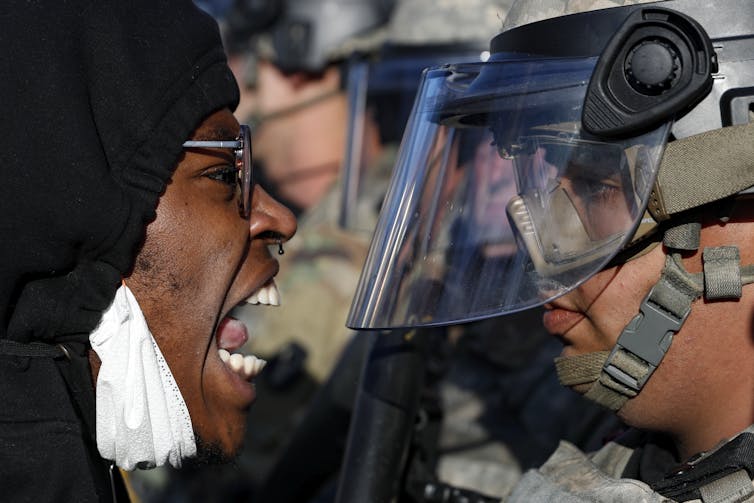
Another tactic that subverts the police gaze is the operation art piece "Mirror Casket" created by a commonage of BLM organizers and artists in 2014. Its aim is to evoke empathy for the Blackness victims of law killings. Activists carried a casket covered with croaky mirrors from the site of Michael Brown'southward killing to the police section in Ferguson, Mo. The police were forced to look back at themselves and meet what systemic terror looks like for Black communities.
Philosopher George Yancy proposes a Blackness counter-gaze that centres on Black lived experiences and sees beyond the supposed invisibility of whiteness. This counter–gaze challenges the cultural norms and practices that make whiteness appear natural, normal and right. The operation of a Black counter-gaze in "Mirror Casket" gives back the trouble of racism to police and others who inhabit whiteness to fix.
Resistance
While BLM'south tactics differ from those of the Civil Rights era, their work is all the same securely informed by that struggle. BLM co-founder Patrisse Cullors points out how activists like the belatedly John Lewis disrupted the status quo. When Lewis and 600 protesters marched across the Edmund Pettus Bridge in 1965, they were confronted by police brutality meant to deter Black people from fighting for freedom.
Historian Carol Anderson explains how Black activists of the Civil Rights era used respectability as a tactic. Lawmakers every bit well equally the general public had their conscience shocked after seeing televised images of law brutality against Black protesters. Blackness activists wielded a quiet intensity in their tactics. They subtly smiled for their police mugshots and calmly read books at white-just lunch counters as a refusal to submit to dehumanization.
Philosopher Michel de Certeau conceived of a "tactic" equally a fashion to construct a space of agency in opposition to institutional ability. He proposed the notion of "making do" to explain how marginalized groups deploy everyday minor acts of resistance using whatsoever tactical materials they have access to.
BLM protesters launch their tactics to reclaim a sense of agency within physical sites of oppression.
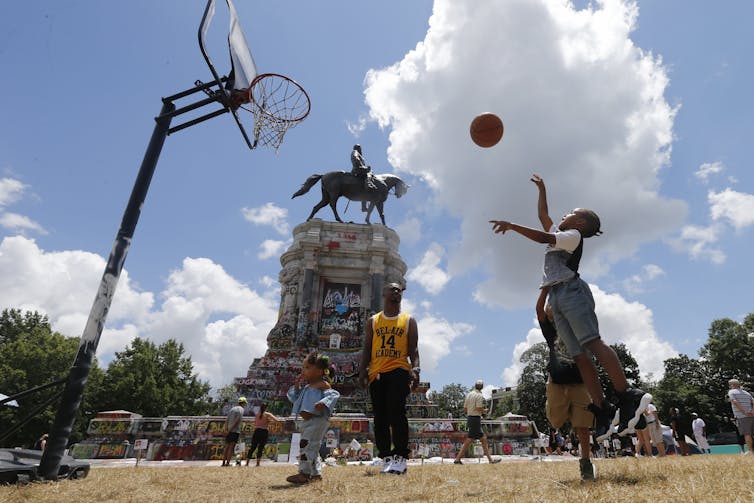
A stunning instance of tactical resistance is the continued defacement of the Robert E. Lee Amalgamated monument in Richmond, Va. A multicoloured blanket of graffiti undermines the hegemonic white power conveyed by the monument. Additionally, Black boys prepare upwards a makeshift basketball game court in front of Lee. Black ballerinas repurposed the monument as a phase for them to dance while giving raised Black ability fists. These pocket-size but potent gestures of resistance strip the monument of its power to intimidate Black people.
Sound likewise has potential for agency. The concept of acoustical bureau describes the miracle of people using their ain sounds and noises to actively resist everyday oppressive soundscapes rather than but acting as passive listeners. The dirge, "Easily up, don't shoot!" is a familiar part of BLM protests. Acoustical agency is a fruitful concept to explain how protesters use more covert sound-making tools to "speak back" to law surveillance and sonic weapons like the LRAD (Long-Range Acoustic Device).
The Chicago police radio system was jammed numerous times past hackers who interrupted dispatch calls about rioters with recordings of the 1988 protestation song "Fuck tha police" by rap group N.West.A. Some may view this tactic of sonic disobedience as a childish prank, just nosotros should instead heed to information technology as a reclamation of acoustical agency.
Various tactics bring hope
How exercise such protest tactics contribute to systemic alter? Disquisitional race scholar Yasmin Jiwani argues that "tactical interventions offering us pedagogies of hope in that, through time and sustained exposure, they might grind down the fortifications of the systems of domination." The images of the graffiti-covered Confederate monument and recordings of the police radio hacks were circulated on social media. When these tactics infiltrate mainstream discourse, the public becomes, at least temporarily, unsettled from their self-approbation.
The unsettling of the public discourse is critical considering documented cases of free voice communication suppression such equally protesters being brutalized past police force and arrested past federal agents in unmarked vans.
Unfortunately, we are simultaneously witnessing a backlash from bourgeois and libertarian public figures against the "illiberal left's" supposed stifling of gratuitous oral communication. This backlash works to maintain the status quo by distracting the public's attention away from the risks protesters are taking to fight for Black liberation.
The Black Lives Thing movement is pragmatic in its methods of disrupting the status quo. Information technology knows that spectacular tactics similar mass protests and defacing racist monuments work in parallel with strategies for demanding legislative changes, law divestment and reparations. Over time, these diverse methods coalesce into powerful forces that push back confronting white supremacist ability structures.
Source: https://theconversation.com/black-lives-matter-movement-uses-creative-tactics-to-confront-systemic-racism-143273

Post a Comment for "course hero discuss global racism and what people are doing to combat it."