Near Caesarea Philippi Peter Identified Jesus by Saying Thou Art the the Son of the Living God

Stained glass window of the Confession of Peter in Luke nine:xx: "But who practise you say that I am?" Peter answered: "The Christ of God".[ane]
In Christianity, the Confession of Peter (translated from the Matthean Vulgate Latin department title: Confessio Petri) refers to an episode in the New Attestation in which the Apostle Peter proclaims Jesus to be the Christ (Jewish Messiah). The proclamation is described in the three Synoptic Gospels: Matthew 16:13–20, Marking 8:27–30 and Luke 9:18–21.[1] [2] Depending on which gospel one reads, Peter either says: 'You are the Messiah' or 'the Christ' (Marker 8:29); or 'You are the Messiah, the Son of the living God',[1] (Matthew sixteen:16), or 'God'southward Messiah' or 'The Christ of God' (Luke 9:20).[3]
The proclamation of Jesus equally Christ is key to Christology; the Confession of Peter and Jesus' acceptance of the title "Messiah" class a definitive argument in the New Testament narrative regarding the person of Jesus Christ.[4] [v] In this New Testament narrative, Jesus not but accepts the titles Christ and Son of God, but declares the declaration a divine revelation by stating that his Father in Heaven had revealed it to Peter, unequivocally declaring himself to exist both Christ and the Son of God.[five]
In the same passage Jesus as well selects Peter as the leader of the Apostles, and states: "Upon this rock I will build my church." Most Christian denominations agree that the statement applies to Peter, but they diverge on their interpretations of what happens after Peter.[6]
The Confession of Peter is besides the name of a liturgical feastday celebrated by several Christian churches, frequently as part of the Calendar week of Prayer for Christian Unity.[vii] [viii]
Gospel accounts [edit]
Narrative comparison [edit]
The following comparison tabular array is primarily based on the New International Version (NIV) English translation of the New Testament.[9]
| Matthew | Mark | Luke | |
|---|---|---|---|
| What people say | Matthew xvi:xiii–14
| Mark 8:27–28
| Luke 9:eighteen–19
|
| What the disciples say | Matthew 16:15–xvi
| Mark 8:29
| Luke 9:20
|
| Jesus selects Peter | Matthew xvi:17–19
| ||
| Jesus silences the disciples | Matthew 16:twenty
| Marker 8:30
| Luke 9:21
|
Groundwork and setting [edit]
In the New Testament, this pericope and the account of the Transfiguration of Jesus which follows it appear towards the centre of the Gospel narrative and jointly marker the beginnings of the gradual disclosure of the identity of Jesus to his disciples.[ten] [11]
The setting is virtually Caesarea Philippi, northeast of the Sea of Galilee and within the Tetrarchy of Philip, and is at the kickoff of the last journey to Jerusalem which ends in the Crucifixion and Resurrection of Jesus.[2]
Peter's Confession begins as a dialogue between Jesus and his disciples in Matthew xvi:13, Marker eight:27 and Luke nine:18. Jesus begins to enquire well-nigh the electric current opinions about himself among "the multitudes", asking: "Who practise the multitudes say that I am?"[ii] The disciples provide a multifariousness of the common hypotheses at the time, ranging from John the Baptist to Elijah, Jeremiah,[12] or i of the (other) prophets.[2] The Cambridge Bible for Schools and Colleges, following Jewish medieval rabbi David Kimhi and theologican John Lightfoot, suggests that Jeremiah "is mentioned as a representative of the Prophets, considering in the Jewish Catechism the book of Jeremiah came offset of the Prophets, following the books of Kings."[13]
Before in the Gospel narrative, these hypotheses about Jesus' identity were provided in Mark 6:14-16 by those in the court of Herod Antipas when he wondered if Jesus was John the Baptist restored to life.[2] [fourteen]
Proclamation and credence [edit]
In the 3 Gospel accounts, after asking about the views of "the multitudes", Jesus asks his disciples nigh their own opinion: "But who practise yous say that I am?" Only Simon Peter answers him: "You are the Christ, the Son of the living God".[1] [15]
Only in Matthew 16:17 Jesus blesses Peter for his answer, and afterward indicates this revelation is the foundational rock of the Church. This begins with:
Blessed fine art thou, Simon Bar-jonah: for flesh and blood hath non revealed it unto thee, just my Father who is in sky.
In approving Peter, Jesus non only accepts the titles Christ and Son of God which Peter attributes to him, merely declares the annunciation a divine revelation by stating that his Male parent in Heaven had revealed it to Peter.[5] In this assertion, by endorsing both titles as divine revelation, Jesus unequivocally declares himself to exist both Christ and the Son of God.[5]
The reference to "my Father" is distinguished in that in the New Testament, Jesus never includes other individuals in such references and just refers to his Father, however when addressing the disciples he uses your Father, excluding himself from the reference.[16]
Choice of Peter [edit]

In Matthew 16:18 Jesus then continues:
And I say also unto thee, That thou art Peter, and upon this rock I volition build my church; and the gates of hell shall not prevail against it. And I will give unto thee the keys of the kingdom of heaven.
The word "Peter" in this verse is, in Greek, "petros", while this "rock" is "petra". It is a play on words, but if the original language was Aramaic the word in both cases is simply "kepha". A distinction that petros meant a stone and petra a solid slice of rocky ground is sometimes suggested, simply Greek use in artifact seems to have been less precise.[17]
The give-and-take "church" (ekklesia in Greek), as used here, appears in the Gospels only over again, in Matthew 18:17, and refers to the community of believers at the time.[4] The "gates of hell" (of Hades) refers to the underworld, and the dwelling of the expressionless, and refers to the powers opposed to God not being able to triumph over the church.[eighteen] The keys of the kingdom of heaven refer to the metaphor of the Kingdom of Heaven beingness a "place to be entered" equally also used in Matthew 23:13, where the entrance to it tin exist close.[18]
Peter's authority is farther confirmed by: "Whatsoever thou shalt bind on earth shall exist bound in heaven: and whatever k shalt loose on earth shall be loosed in sky." Equally discussed beneath, diverse Christian denominations have assigned different interpretations to the authority granted in this passage.[ commendation needed ]
Jesus silencing the disciples [edit]
All three of the Synoptic Gospels end the account with Jesus telling the disciples not to reveal that he was the Messiah to anyone — an instance of the motif of the Messianic Secret.[ citation needed ]
Denominational issues [edit]
Interpretations [edit]
Various Christian denominations translate Matthew xvi:18 in unlike ways. Although most denominations concur that the statement applies to Peter, they diverge on their interpretations of what happens afterwards Peter.[6]

Stained drinking glass window in a Catholic church depicting St. Peter'due south Basilica in Rome sitting "Upon this rock," a reference to Matthew 16:eighteen. Most nowadays-day Catholics interpret Jesus as saying he was building his church on the rock of the Apostle Peter and the succession of popes which claim Apostolic succession from him.
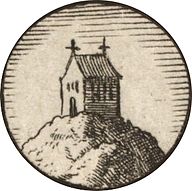
A 17th century illustration of Article VII: Of the Church from the Augsburg Confession, which states "...one holy Church is to continue forever. The Church is the congregation of saints, in which the Gospel is rightly taught and the Sacraments are rightly administered." Hither the rock from Matthew xvi:18 refers to the preaching and ministry of Jesus equally the Christ, a view discussed at length in the 1537 Treatise.[19]
In the Roman Catholic Church, Jesus' words "upon this rock I will build my church building" are interpreted as the foundation of the doctrine of the papacy, whereby the Church of Christ is founded upon Peter and his successors, the Bishops of Rome.[xx] Jesus' next statement, "and the gates of hell shall non prevail against it." are interpreted as the foundation of the doctrine of papal infallibility.[21]
Some Protestants believe that the poetry states that Peter was the foundation stone of the Church, merely exercise non take that information technology applies to the continuous succession of popes, as the Bishops of Rome. The statement "and the gates of hell shall not prevail confronting information technology" is ordinarily taken to mean that the Church will never go extinct.[6] [21] Some Protestant evangelical groups adhere to the interpretation that it is Peter'due south "confession" itself that is "the rock on which volition be built the Church of Jesus", i.east., the church will exist built on Jesus alone as the foundation rock of his church. This interpretation normally uses the argument of the deviation betwixt petros and petra in Greek ("You are Peter [petros] and on this rock [petra] I volition build my church.")
The Eastern Orthodox and Oriental Orthodox churches encounter Jesus' words "whatsoever g shalt bind on world shall be bound in heaven" as bestowing first upon Peter what was later bestowed upon all of the Apostles collectively. The Orthodox believe in the infallibility of the Church as a whole, only that any individual, regardless of their position, can exist subject to error.[half dozen]
Ecumenical meetings among unlike denominations have taken identify regarding these interpretations, but no terminal agreement has emerged.[6]
Commemorations [edit]

Plaque at Nantes Cathedral: "Thou art Peter, and upon this rock I will build my church."
The Roman Catholic Church building celebrates the Feast of the Chair of St. Peter on 22 February in the Full general Roman Calendar. In the General Roman Calendar of 1960, the feast is historic on 18 January. Some Anglican and Lutheran churches celebrate the Banquet of the Confession of St. Peter on 18 January.[8]
The Confession of Peter is the offset of the Week of Prayer for Christian Unity, actually an octave rather than a calendar week, and was originally known as the Octave of Christian Unity. It is an international Christian ecumenical observance that began in 1908. Information technology spans from 18 Jan to 25 January (the Banquet of the Conversion of Saint Paul).[8]
Encounter also [edit]
- Chronology of Jesus
- Denial of Peter
- Life of Jesus in the New Testament
- Transfiguration of Jesus
References [edit]
- ^ a b c d Who practise you say that I am? Essays on Christology by Jack Dean Kingsbury, Marking Allan Powell, David R. Bauer 1999 ISBN 0-664-25752-half dozen page xvi
- ^ a b c d e The Collegeville Bible Commentary: New Testament by Robert J. Karris 1992 ISBN 0-8146-2211-9 pages 885-886
- ^ Notation that some translations add a few words to Luke's version, namely 'You lot are' and 'sent from [God]' or 'whom [God] has sent'. Similar to the other gospels, some translations render Χριστὸν equally 'Anointed One' rather than 'the Christ' or 'the Messiah'. "Luke 9:20". Biblehub.com. 2011. Retrieved 8 January 2021.
- ^ a b The Gospel of Matthew by Rudolf Schnackenburg 2002 ISBN 0-8028-4438-iii pages 7-nine
- ^ a b c d I Teacher: Jesus' Instruction Role in Matthew's Gospel past John Yueh-Han Yieh 2004 ISBN 3-eleven-018151-7 pages 240-241
- ^ a b c d e The People's New Testament Commentary past Chiliad. Eugene Slow, Fred B. Craddock 2004 ISBN 0-664-22754-6 page 69
- ^ Pocket Dictionary of Liturgy & Worship by Brett Scott Provance 2009 ISBN 978-0-8308-2707-seven folio 59
- ^ a b c Exciting Holiness: Collects and Readings for the Festivals by B. Tristam ISBN 1-85311-479-0 Canterbury Press 2003 pages 54-55
- ^ "Online Bible – New International Version". Biblehub.com. 2011. Retrieved 8 January 2021.
- ^ The Christology of Mark'south Gospel by Jack Dean Kingsbury 1983 ISBN 0-8006-2337-1 pages 91-95
- ^ The Cambridge Companion to the Gospels by Stephen C. Barton ISBN 0-521-00261-3 pages 132-133
- ^ In Matthew'due south business relationship simply: Matthew xvi:xiv
- ^ Cambridge Bible for Schools and Colleges on Matthew sixteen; John Lightfoot's Commentary on the Gospels on Matthew 16 and on Matthew 27, all accessed 25 January 2017
- ^ The Gospel of Mark, Volume 2 by John R. Donahue, Daniel J. Harrington 2002 ISBN 0-8146-5965-nine page 336
- ^ Christology and the New Testament by Christopher Mark Tuckett 2001 ISBN 0-664-22431-8 page 109
- ^ Jesus God and Human being past Wolfhart Pannenberg 1968 ISBN 0-664-24468-eight pages 53-54
- ^ Peter: Disciple, Campaigner, Martyr by Oscar Cullman 2011 ISBN 1602584133 page twenty
- ^ a b The Gospel of Matthew (Sacra Pagina Series, Vol 1) by Dainel J. Harrington 1991 ISBN 978-0-8146-5803-1 folio 248
- ^ Treatise on the Ability and Primacy of the Pope, paragraph 22 and following
- ^ Upon this Rock: St. Peter and the Primacy of Rome in Scripture and the Early Church by Stephen One thousand. Ray 1999 ISBN 978-0-89870-723-6 pages xi-fifteen
- ^ a b Papal infallibility: A Protestant Evaluation of an Ecumenical Upshot by Mark Eastward. Powell 2009 ISBN 978-0-8028-6284-6 pages 35-40
Source: https://en.wikipedia.org/wiki/Confession_of_Peter

Post a Comment for "Near Caesarea Philippi Peter Identified Jesus by Saying Thou Art the the Son of the Living God"